Showing posts with label Previews. Show all posts

Tuesday, January 30, 2007

So Many Games So Little Time

Since I got my hands on Battlelore I only got to play 3 complete games. I find Battlelore very balanced. At all points of the game the tide of war could go either side. To some amateurs the game looks pure random with cards and dice putting too much variable in the game to make any strategy a null. Strangely enough the game guys that play CCGs.

Battlelore has more in common to CCGs then many of the board games that I have played, but of course with a twist. Engines like dealing the situation with what you got, and using cards to bend the rules are present here too. The war council lets players mold their own game avatar, shaping their own rules. This feature is used in many CCGs. Hand size, power, and ability of a player is determined by the war council.

Unlike CCGs however battle are fought using a ratio instead of a number versus number system. A standard short swordsman has a 1 in 3 chance of hitting another short swordsman and 1 in 6 chance of hitting a calvary man. The dice brings allot of randomness to a battle but combined with the ratios of hitting it feels more like a real war. Think of it as a general instead of an omnipotent creature giving an order to the troops.

The reference cards are pure genius. Any gamer with a common sense could read the cards and get the gist of the game in moments. This is where CCG gamers shine. They are suppose to not mind reading lines of text from a card.

So far I got no complains about the game except for the limited number of players. That could be rectify yes but it is not part of the official rules.

Sunday, October 29, 2006

My First Look At Niagara


Niagara was produced in 2004 by Zooch Verlag (Rio Grande for English version) . It is a board game for 2 ot 5 players. Niagara has won many titles in its name, it was GAMES Magazine Family Game Nominee 2006, it won MENSA Best Mind Game 2005, it won Spiel Des Jahres Game of the Year 2005, and it was Deutscher SpielePreis 2nd place winner 2005.

Niagara currently has 2 expansions, Diamond Joe, a free expansion which adds a trader canoe to the game, and Spirits Of Niagara, which adds new cards, new canoes, new game elements, and makes the game into a 2-6 player game.

The quality of the game components are excellent. Wodden canoes, thick cardboard cards/chits, clear plastic disc, colored plastic (crystal like) gem stones, and a very think double layered game board, are the components you should expect when buying this game. The game component holding trey that comes with the game is perfect, better then most of the board games I have seen.

The game revolves around collecting these gems stone located along a river (game board). There are only 7 gemstone at each of the 5 gemstone reservoirs along the river. Players needs to collect 5 different colored gemstones, or 4 same colored gemstones or 7 of any combination of gemstones to win the game.

Players needs to collect these gemstones while limited to the number on the paddle cards/chits in their hands (1-6 + 1 weather card/chit). The river always flows towards the fall at the same rate as the slowest canoe (the smaller numbered paddle played) plus the weather (-1 to +2). Canoes that have fallen over the waterfall could be rescued at a payment of 1 gemstone. Players however has to play all the cards/chits in their hands before replenishing their cards/chits.

Another twist to the game is intrigue in the form of weather control and thievery. Players can manipulate the speed of the river by playing the weather card/chit. Players may add -1, 0, +1, or +2 to the river speed. Empty canoes coming up river may steal another canoes gemstone by ending their move exactly in the same spot at another canoe.

These game mechanics makes this game a thinking gamers game. Players needs to balance their goals with the flow of the river and the options they have using math and logic. Even at first glance I could see why this game won so many titles and awards.

Wednesday, October 25, 2006

My First Look At Samurai


We know what a samurai is. I don't need to preview them. This however is my first look at Samurai a board game by Reiner Knizia and the English version of this game is published by Rio Grande. With both those names on a box you know you can't go wrong. I first heard of this game on my favorite board game audiocast The Spiel.

The game box is big mainly to accommodate the multi-piece map of Japan game board. Thick cardboard hex tiles, a fordable Japanese style blind to hide your tiles and winnings behind, and a bunch of plexiglass Buddhas, tall hats, and rice fields. The plexiglass pieces are very nice. I kinda wish all the wooded pieces from other games are made of the same stuff instead.

Basically Samurai is a tile laying game. At first glance it seems that the game came with too few components for what the game is suppose to be but I was wrong. The game plays very nicely. The goal of the game is to influence and claim the plexiglass pieces by placing tiles with the proper icon and number. when the piece is surrounded on land with tiles the number on the tiles with the proper icon is added and the one with the highest total claims the piece.

The only truly complicated part of the game is scoring. Unlike other games it does not matter how much pieces a player claims. The objective is to have the most majority of the type of pieces. A majority of 2 or 3 is a straight win. A majority of 1 calls for a comparison of other pieces that are claimed.

Sunday, October 22, 2006

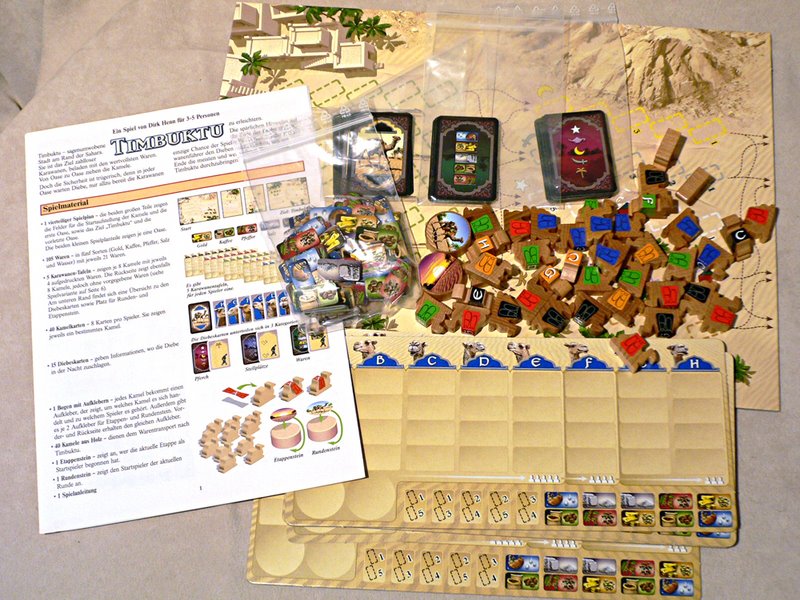
My First Look At Timbuktu


Timbuktu is a game for 3 to 5 players. It is a deductive game, my favorite genre.

The game comes with very nice think card board, game boards (use 2 or 3 or 4 depending on number of players), camel tracking board, and item chits. There is also a lot of wooden camels and 2 short think cylindrical wooden tokens, a sheet of stickers for the camels and tokens, and a rule book.

The game box is large, the game pieces will not disappoint and they give you enough zip lock bags to keep all the game bits. Nice!

The game is simple. The goal is to move your camel caravan and save as many of your cargo as possible thus getting the highest score. Throughout the game your items are going to be stolen. Each item gives you points equal to the number of items that are stolen.

The detective work comes in when each round you get to see a set of three cards. These cards tells you which items from a camel in which stall, and in which lot it is going to be stolen from. Each round players will get to look at up to 3 out of the 5 sets of cards. Based on the cards and opponent movements players must deduce the safest place to put their camel.

It is a deductive game. Expect some downtime during the game spent deducing the best places to place the camels. Game time differs with number of players.

Monday, October 16, 2006

First Look - Hoity Toity

I first discovered Hoity Toity on Board Games With Scott a board game videocast.

Hoity Toity is one of those deep but simple games. The game is a great gateway game. Introducing new players to many aspects of modern board games. It has very simple but useful high quality pieces. One small gameboard/score track,  6 small card decks for player actions, 1 large card deck of "collectibles" card, and six wooden meeples. Interestingly the game is very communal lots of player interaction with little to no downtime and for 3 to 6 players. The game seems to have perfect timing. It flows like it should it ends when it should. Overall a very well rounded game.

Thursday, September 14, 2006

My Look At - Ra


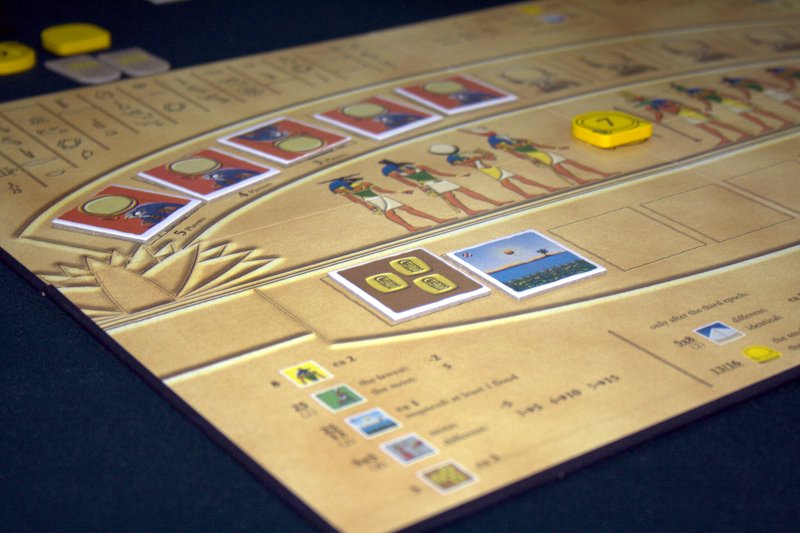
Ra! Ra! Ra! Only one game that could make completely innocent gamer chant the name of an ancient pagan Egyptian god. Ra is a Reiner Knizia game published by Rio Grande, a combination that will not wrong you.

Ra is at its core is an auction game for 3 to 5 players and could be played in about 60 minutes. The goal of the game is to be the one who scores the most points. The games comes in a medium small sides box, inside you will get a board used for auctions, hundreds of cardboard tiles, a bag to put it all in, scoring cardboard counters with denominations, a think wooden Ra silhouette figure, and some wooden sun disks (chips) used for bidding.

The game play is cunning. Players has to constantly evaluate the value of tiles and sun disk on the board. In the beginning of the game each player randomly chooses a fixed pile sun disks. Each turn a player may either draw a tile from the bag and place it on the board, play a god tile, or invoke Ra.

The types of tiles vary. The tile types are Culture, Monuments, Pharaohs, Flood/River, Gold, Gods, Catastrophe and Ra. Players gets points if the player posses at least 3 different culture tiles, players gets minus points for not having at least 1 culture tile. The player with the most pharaoh gets points while the player with the least amount of pharaohs gets minus points. River tiles gives one point each only if the player also posses a flood tile which also give one point. Gold tiles gives three points. Catastrophe tiles takes makes player discard tiles. God tiles lets player discard it for a tile on the board. Monument tiles only score at the end of the game, Monuments score for every set of unique and set of identical tiles. Ra tiles invokes Ra. All these tiles except Ra could only be obtained in auctions.

So what happens when one invokes Ra in the game? An auction. Beginning with the player to the left of the one who invoked Ra players place bets in the form of sun disks. Each sun disk has a fixed value and no two are the game. The auction is for every tile on the board plus the sun disk in the middle of the board. The winning disk replaces the central disk and is up for grabs in the next auction. If voluntarily invoked the player who called Ra must bid if every one else passes. If involuntarily invoked by drawing a Ra tile or by filling up the auction board with tiles all players may pass. The auction continues or all tiles are discarded if the board if full.

Constantly players have to weigh the value on the board. Is it valuable to me? Is it valuable to someone else? Should I call Ra and chance winning the tiles? Should I wait? Or Should I throw others game by calling Ra while the board is mostly empty?

The possibility is endless and balanced. Players with high sun disk must chance loosing it to someone else to be used in the next round and getting a risk a smaller sun disk for the next round. A player that constantly calls Ra might find himself running out of sun disks early and so on.

The game is played in 3 scoring rounds. A round ends when all sun disks are used or when the bard is filled with Ra tiles. In the last round Sun Disks and Monuments also scores.

The game is excellent. It has the element of openness, balance and deduction that I love in a board game. Like I said earlier: When you see Reiner Kenizia and Rio Grande on the same box, you can not go wrong.

Friday, September 08, 2006

My Look At Citadels


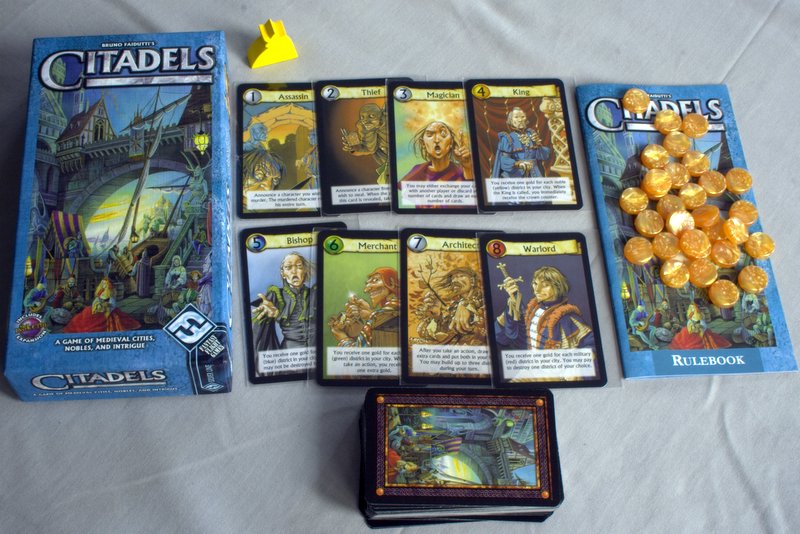
Citadels is a highly recommended card game of intrigue, strategy and deduction. The game consist of a wooden crown token some plastic orange candy looking tokens for gold and lots of cards that are shorter in width then standard cards. The most current version of Citadels also includes cards from its expansion Dark cities hitch consist of 14 purple district cards most with special abilities and 10 cards representing influential characters of the kingdom. The expansion however does not actually feel like an expansion but more like a variation of the game as the expansion is meant mainly to replace cards and add very little to the deck.

The game seems very simple at first. The goal is to score the most points by being the first to build the most extravagant citadel (8 buildings) with the most variety of districts (5). Each turn a player chooses a prominent figure of the kingdom (9) to influence. The player may then either take 2 gold coins or draw 2 building cards, place one of the cards in the bottom of the building deck and the other into his or her hand. Now the player may choose to pay and build a building. Arther that the next player takes his or her turn.

But that is not all for there are twists to the game. At the beginning of each round the player with the crown marker (marks the first player) takes the deck of influential figures, shuffles it, place a fixed number of cards face down and a fixed number of cards face up, based on the number of players. That player then chooses whom to influence and then pases the deck to his or her left. The influential figures determent the players turn sequence, determines who gets the crown token next turn and gives each player a unique ability.

This element of influential figures and the special ability that they give that adds the intrigue, strategy and deduction to the game. Abilities ranges from making a player with the targeted influential figure skip their turn to the ability to add a gold for each building of the same district and the ability to destroy a building.

Citadels has the components, game play and price that makes it a must have in any game library. It does not take a long time to play making it perfect for a filler game or as a main game.

Tuesday, August 08, 2006

First Look - Fury of Dracula

Fury of Dracula is a 2 to 5 player game where 1 player plays the vampire Dracula and the other players plays as the vampire hunters. The goal of the game is to defeat Dracula before Dracula kills everyone or time runs out.

Fury of Dracula is brimmed with atmosphere. Each game engine and system fits well and with a reason.

There is a night and day cycle, at night Dracula is stronger.

Seating order is important, players gets their characters based on turn order. This might seems bad at first taking away the freedom of choosing your own character. There is a good reason for this, the game balances itself with the number of players and the players abilities balances out with the game. Not only that, each characters ability fits like a glove.

During the game players will be able to gather items and event cards. Event cards are your typical game modifiers. However the items has a very interesting engine, they balance out. Mundane weapons such as knives and guns works as you would expect with common enemies but does almost nothing to Dracula. There are only some event card and some rare items that are effective against Dracula. These cards are powerful more often only against Dracula. This makes the game epic and misunderstood. Some say that Dracula is too easy to be killed because he is weak. Actually he is easily destroyed because the only way to kill him is by powerful extraordinary means. Do not expect to damage Dracula in a fist fight, or a gun fight, he will own you. Players will need to search for Dracula avoiding his traps gather means to destroy him and actually defeating him within the time limit.

Like any board game the fun factor of this game is largely based on the players. Dracula player needs to be sneaky and with a plan. Hunters needs to be cleaver and choose their moves wisely.

The first impressions of this game is good. High quality components, beautiful art, good size with ample storage space, heavy with theme and atmosphere. Do not expect an expansion for this game, its engine is so tightly woven that I do not think that it is possible.